FLASH welcomes its first user groups after shutdown
A new round of user experiments starts this week at DESY's free-electron laser FLASH. The first users are researchers from the Max Planck Institute for Nuclear Physics in Heidelberg.
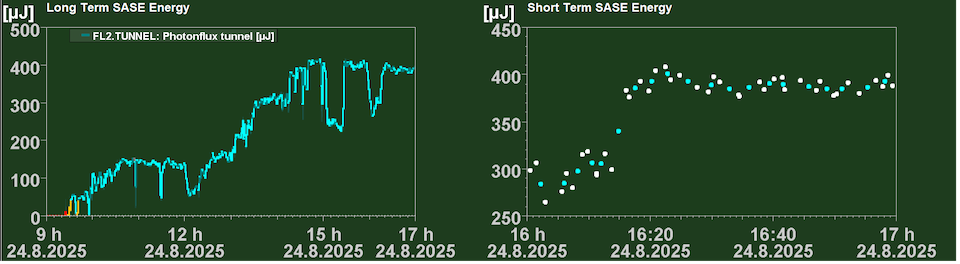
A new round of user experiments is starting this week at DESY's free-electron laser (FEL) FLASH. During a long FLASH2020+ shutdown, the FLASH1 branch was completely replaced and converted into an externally seeded FEL, which is currently being gradually put into operation. The practically unchanged FLASH2 FEL branch was successfully put back into operation very quickly. Just three weeks after the FLASH accelerator restarted, FLASH2 achieved its usual excellent beam parameters for the FEL flashes.
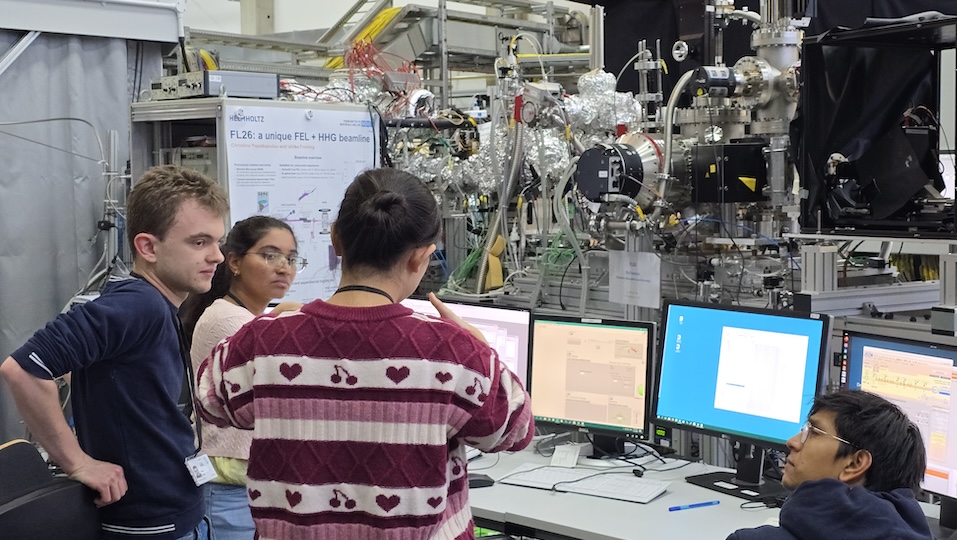
The operating team in the accelerator control room (BKR) could then start to work with the scientists at the beamlines and measuring instruments in the experiment halls to prepare , ‘'try out" and optimise the settings for the first three of six experiments, which will take place before Christmas 2025.
This round of new user experiments kicked off on 3 November. A team of researchers led by physicist Weiyu Zhang from the group of Robert Moshammer and Thomas Pfeifer at the Max Planck Institute for Nuclear Physics in Heidelberg are the first users of this season. Their experiment is in the field of atomic and molecular physics and was very highly rated by proposal review panel composed of international experts. The researchers will now carry out their experiment on the so-called Reaction Microscope in the Kai Siegbahn experimental hall at FLASH2. They will study the Jahn-Teller effect, i.e. the time-dependent, ultrafast geometric distortion of a molecule, which they will first excite energetically with an FEL flash and then observe how it stretches or compresses its shape in fractions of a billionth of a second. Theory predicts different pathways for these deformations, which also have different durations. This first FLASH experiment of the new campaign should now enable the precise differentiation of these pathways. The Jahn-Teller effect has implications in many areas of chemistry, as molecules can achieve more energetically favourable states through these geometric distortions. This affects, for example, the synthesis of complex molecules and their stability.
The FLASH experiment aims to provide deeper insights into quantum chemistry by improving our understanding of the rapid movements of electrons – the fundamental "glue" of chemistry – and the associated movements of atomic nuclei in molecules.