
The spark for the PETRA IV injector: clever, cost-effective laser focus unveiled
Tunable laser optics scheme worked out for miniature particle accelerators based on plasma wakefields
The mirrors, lenses, and other equipment that focus lasers have to handle a lot. The optics for a high-power laser that drives a plasma accelerator, even more so: they need to handle high energies, be exceptionally precise, have a high stability, and be easy to adjust on top of that. Normally such optics include components so complicated as to be inflexible – suited often only for one particular manner of use – in addition to being individually quite expensive. However, scientists working on plasma accelerators at the German research centre DESY have figured out a relatively simple solution to turn more common high-power laser optics components into a highly tunable setup that matches the performance of the more complicated versions. The setup, which is planned to be implemented in the plasma accelerator that will drive the future PETRA IV light source, is demonstrated in a report in the journal Optics Letters.
The lasers for high-energy plasma electron accelerators have several major performance hurdles. They need to energise and shape the plasma that accelerates the electrons. In addition, they need to be consistently threaded through a tiny plasma structure that is about 50 millionths of a metre wide – that requires major stability. Normally, the solution for focusing the laser beams can include different complex optical components, each used for creating a particular focal shape. Those complex optics have become a hurdle to experimenting with different modes of acceleration and finding potentially more efficient methods.
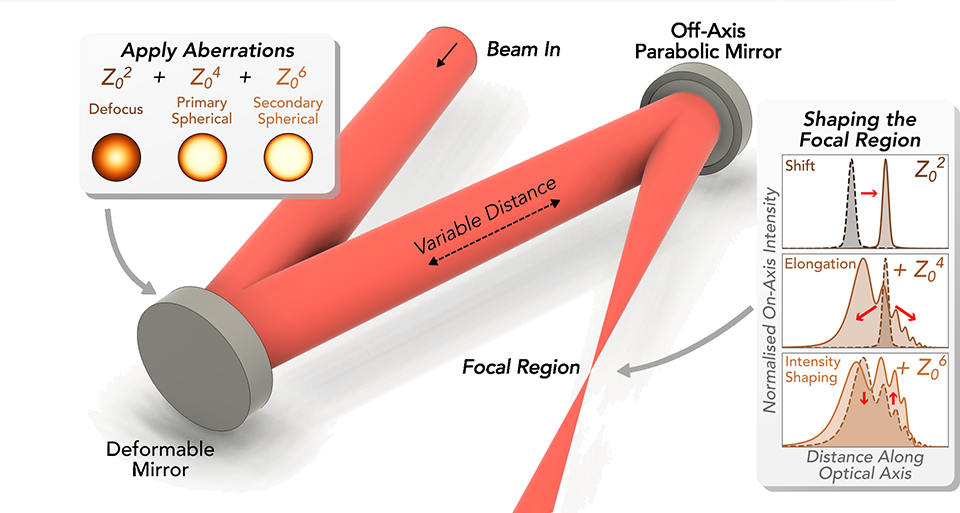
However, the team developed a setup that may solve this, all based around two standard optical components. The team’s setup combined both these optics in a new way that eschewed the use of the more complex focusing optics while maintaining their nominal effect and adding tunability. This involved using components typical to a plasma acceleration setup: a deformable mirror and a parabolic mirror. A deformable mirror can be bent and shaped in different ways during use, depending on what is needed for the acceleration. Typically, these mirrors remove aberrations in the laser, while an adjacent parabolic (bowl-shaped) mirror focuses the laser beam.
“While these deformable mirrors normally remove imperfections from a laser beam, here we want to use them to add controlled amounts of imperfections in order to shape the laser focus so we can use it for a wider variety of applications,” says Peter Blum, the study’s first author and a doctoral student working in the plasma acceleration group at DESY. These controlled aberrations that the team added to their deformed mirror can stretch and shape the focus of the high-intensity laser beam. “This is similar or even the same as the setups would be in most labs – we’ve just used them in a way that hadn’t been tried before,” Blum explains.

“People are starting to look more at novel acceleration schemes based on structured laser foci created by complex optics,”, says Rob Shalloo, Emmy Noether Research Group Leader at DESY and the study’s principal investigator. “But what we’ve shown here is that you can actually use your existing mirrors to effectively do the same job – which in the end is much more sustainable and flexible than having to purchase new additional optics.” That flexibility is useful for the PETRA IV injector.
“This is one of the crucial key technologies for PETRA IV,” says Andreas Maier, leader of DESY’s plasma acceleration group, DESY lead scientist, and one of the paper’s co-authors. Using a suite of simulation tools, the team applied PETRA IV use cases to demonstrate the flexibility of the system, showing how the wide range of focal shapes could work to affect plasma generation. They found the setup would work well for generating the plasma waveguides that will give the initial boost for electrons heading into the new PETRA IV synchrotron ring.
Additionally, the relative ease of constructing the setup makes it accessible for other labs. The team tested various possible focusing scenarios that could be applicable to other use cases. “By making use of equipment already existing in such systems, this technique can be applied not just here at DESY, but also at other plasma accelerator facilities,” Shalloo says. This would help enable the development of new plasma acceleration schemes at other institutes.
“DESY makes many innovations – and sometimes, it’s not what we’ve built, but rather how we’ve built it that matters,” says DESY Accelerator Division Director Wim Leemans, who is also a co-author of the paper. “The focusing setup our team has designed is an elegant solution that helps bring the future technology of plasma acceleration not just into PETRA IV, but potentially also into a broader range of scientific and technical applications.”
Reference
Blum et al., "Programmable focal elongation and shaping of high-intensity laser pulses using adaptive optics," Optics Letters, 2025.