
X-rays pave the way for the quantum revolution
An international team involving Helmholtz centres, European large-scale facilities, and leading universities shows in a recent Advanced Functional Materials publication how cutting-edge X-ray methods can overcome key obstacles in quantum device development.
Using ultra-precise X-ray light from synchrotron and free-electron laser facilities, researchers are opening a new gateway to next-generation quantum technologies. An international team involving Helmholtz centres, European large-scale facilities, and leading universities shows in a recent Advanced Functional Materials publication how cutting-edge X-ray methods can overcome key obstacles in quantum device development.
Whether superconducting qubits, spin noise in semiconductors, single-atom qubits, or exotic topological states – all rely on extremely fragile quantum effects. Tiny material defects or minute strains can already compromise their performance. This is precisely where synchrotron radiation comes into play: it reveals what was previously invisible.
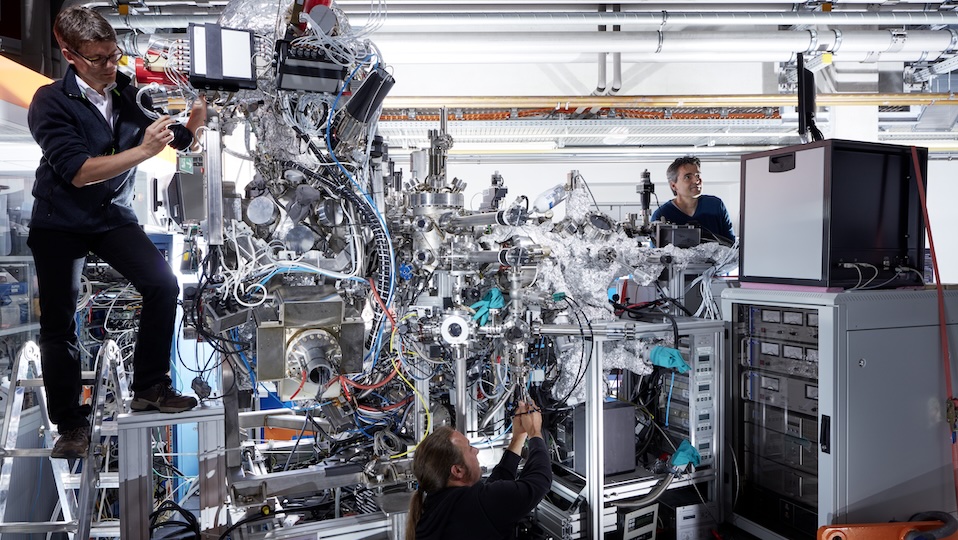
Today’s X-ray techniques allow researchers to probe nanometre-scale structures, chemical states of individual atoms, magnetic properties, and even device function under real operating conditions – non-destructively and with unprecedented precision. This makes it possible, for example, to identify loss-inducing oxide layers in superconducting qubits, detect individual dopant atoms, or visualise local strain fields in semiconductor nanostructures.
The study also highlights how X-ray quantum optics is opening new experimental frontiers and how quantum computing, in turn, may accelerate data analysis at large-scale photon facilities.
“X-ray light is becoming a key tool of the quantum era,” says Britta Redlich, research director for photon science at DESY. “It not only helps us understand the building blocks of future quantum computers – it enables us to improve them.”
Through the synergy of Europe’s leading research infrastructures and advanced photon sources, a new scientific bridge is emerging: “X-rays for Quantum” – a cornerstone for the next generation of quantum technologies.
Original publication
O. Rader, S. Pascarelli, K. Attenkofer, et al. “Synchrotron Radiation for Quantum Technology.” Adv. Funct. Mater. (2025): e01043.