


A sharp close-up of human thought
How PETRA IV is redrawing the map of the brain
Thanks to the PETRA III synchrotron at DESY, it is already possible today to visualise the cellular architecture of the human brain in high resolution and three dimensions using X-rays. With the planned PETRA IV synchrotron, it will be possible to map not only neurons, but also their connections and contact points – the synapses – and thus the entire neural network.
A team led by physicist Tim Salditt from the University of Göttingen is using a special technique at PETRA III, called phase contrast tomography, to examine tissue samples from the human brain.
The potential applications of this technique are manifold: from research questions on neurodegenerative diseases to studies of the hippocampus and cerebral cortex to the structure and functioning of the cerebellum at the cellular level.
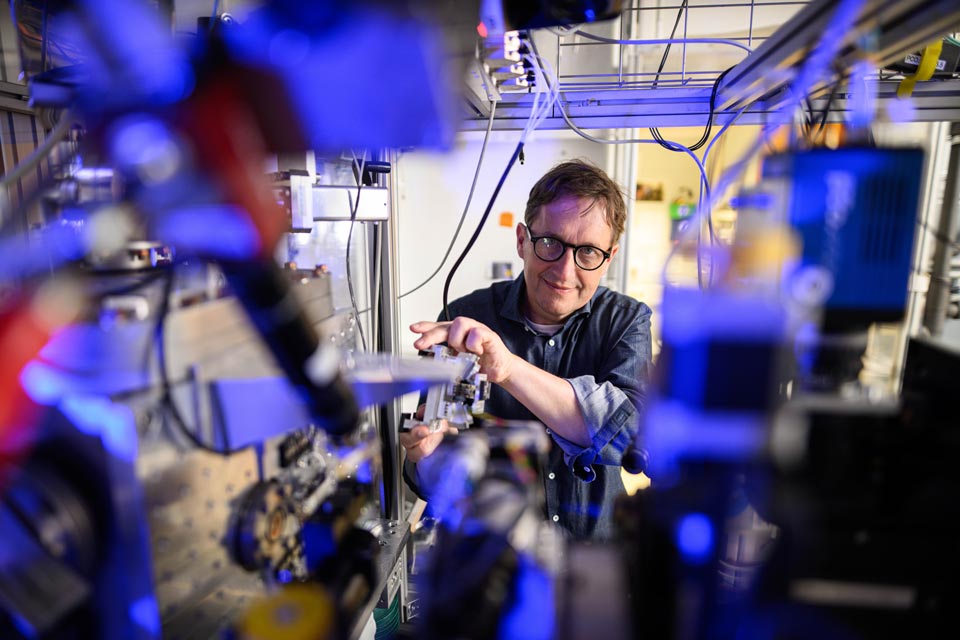
The cerebellum, for example, is a region of the brain with an extremely high density of nerve cells (neurons). It performs many complex functions. Among other things, the cerebellum coordinates movement, maintains balance, is responsible for fine-tuning motor skills and learns automated movement sequences – making it crucial for humans to walk upright. “However, we do not know exactly how the neurons are positioned in relation to each other, what their relationship is, and how the three-dimensional architecture changes in certain diseases,” says Salditt. Using an optical microscope on histological tissue sections, this can so far be examined only in two dimensions. Furthermore, the resolution is not sufficient to identify every cell or even fine structures within the cell. Synchrotron radiation, in contrast, allows us to look deep into the tissue, which is impossible with other microscopic methods such as electron microscopy.
Entire regions of the brain are imaged in three dimensions and with high resolution using brilliant X-rays.
In this way, Tim Salditt’s team was able to precisely measure around 1.8 million nerve cells at PETRA III – in a tiny tissue cube measuring just one cubic millimetre. Such mapped data is collected in digital atlases of the brain, which other scientists can use to carry out simulations and studies. The team investigated changes in the neural architecture in Alzheimer’s disease and multiple sclerosis in close collaboration with medical professionals. Precise insights into other organs are also possible: for example, damage to blood vessels in the heart and lungs caused by Covid-19 was visualised as well.
At PETRA III, Tim Salditt is currently working mostly with pixel sizes between 50 nanometres and just over 500 nanometres. PETRA IV is expected to produce sharp images even at 10 nanometres and thus promote completely new insights. To illustrate the scale involved, here is a comparison: the diameter of a human hair is around 50 000 to 100 000 nanometres.
“PETRA IV can be seen as a huge and incredibly versatile analytical tool that makes possible what is still a dream of the future today – not only for biomedical research and neuroscience, but also for materials research as well as the analysis of environmental samples and even cultural assets. PETRA IV will be an important tool for the development of new technologies in Germany and Europe.”
PETRA IV is expected to deliver synchrotron radiation that is a hundred times more brilliant than at PETRA III and thus to help refine our knowledge of healthy tissue and tissue affected by disease. PETRA IV will image samples from vital organs with significantly higher picture sharpness, in three dimensions and also with temporal resolution.
Biomedical research will make considerable progress with the modernised PETRA particle accelerator – especially when it comes to the brain.
An even better X-ray microscope such as PETRA IV will revolutionise imaging.
Tim Salditt explains: “If we really want to understand how the brain works, it’s not enough to just follow individual nerve signals or look at how individual cells communicate with each other. We need to be able to see exactly how a neuron is connected to all the others – essentially the complete circuit diagram of the brain with all its connections, including the synapses, in super-high resolution.”
The aim is to be able to “zoom into” the brain to see individual details clearly, but also to “zoom out” again to see the big picture – in much the same way as with online map services. Until now, this has only been possible in tiny areas. PETRA IV will enable much larger parts of the brain to be imaged and examined in this way.
The speed of experimentation is also particularly important: while large samples are processed at PETRA III over hours or days, the same process will be completed in a few minutes at PETRA IV. This means that, instead of just ten, hundreds or thousands of samples can be examined automatically and also evaluated more quickly. This takes research from individual cases to reliable, statistically significant results.